
For most people, the process of getting a dermal filler done is similar to that of going for a haircut. You see a result you like and you go with a name you know. That instinct works out fine for plenty of patients. For those it does not, the consequences sit on their face for the better part of a year. Revolax Deep Filler is one of the most used hyaluronic acid fillers in UK clinics right now, and whether it is right for you deserves a proper answer before you step through that door.
What Revolax Deep Actually Is?
Revolax Deep dermal filler is made up of a hyaluronic acid gel cross-linked and marked with a Class III CE mark, making it a completely safe medical device that can be used clinically in the UK. Its composition consists of 24 mg/ml of hyaluronic acid combined with 0.3% lidocaine hydrochloride, which is a local anaesthetic incorporated into its formula, making the injection more comfortable.
There are three types of Revolax Filler: Fine, Deep, and Sub-Q. The main thing about all three of these fillers is that they contain the same concentration of 24 mg/ml of HA.
| Product | Viscosity | Intended Depth | Typical Duration |
| Revolax Fine | Lowest | Superficial dermis | 9 to 12 months |
| Revolax Deep | Mid-range | Mid-to-deep dermis | 12 to 18 months |
| Revolax Sub-Q | Highest | Deep subcutaneous | 12 to 18 months |
Using incorrect viscosity in the incorrect layer can lead to more than just poor results, since visible ridging and overcorrection are possible. It can also make dissolving the filling a challenge. That detail alone explains why the injector’s anatomical judgement matters more than the patient’s product preference.
The Fields It Covers and Where It Is Not Appropriate Anymore
Revolax Deep filler injection is used for the mid-to-deep dermis, where volume and structure need some correction. The viscosity of Revolax Deep lies in the clinically versatile middle ground; high enough to maintain its shape while moving through the tissues, yet low enough to blend in.
Treated areas that it can perform well include:
- Revolax Deep filler for nasolabial folds works better because of its density which helps treat prominent laugh lines without causing skin irregularities that a thicker product may cause.
- Marionette lines around the mouth.
- Lip augmentation, specifically classic horizontal volume where body and definition matter.
- Revolax Deep filler for chin augmentation and mild jawline refinement.
- Non-surgical rhinoplasty and deeper forehead lines.
Very fine superficial lines call for Revolax Fine; a denser gel in shallow tissue creates ridging that is both visible and palpable. Significant cheek scaffolding or structural projection over bone belongs to Sub-Q, which handles the deepest placement planes where mid-range viscosity simply cannot provide enough support.
Patients may also encounter Lumifil Dermal Filler as an alternative during consultation. Like Revolax Deep, it is a cross-linked HA filler, and the choice between them should be driven by the practitioner’s clinical experience and the patient’s anatomy, not brand familiarity on either side of the conversation.
Suitability of Booking this Procedure
The things to consider before dermal fillers treatments go beyond just aesthetic issues. Medical suitability is the basis of whether the procedure is appropriate, and neglecting this can be where all the issues arise from.
Suitable candidates are likely to be 18 years old or over (injecting cosmetic fillers to minors under 18 years of age in England is a crime as per the Botulinum Toxin and Cosmetic Fillers (Children) Act 2021), having no known allergies to hyaluronic acid or lidocaine, neither being pregnant nor lactating, having no active skin infections or inflammatory acne around the treatment site, and having no blood-thinning drugs or changes approved by a doctor.
These patients are those who have a known allergy to either HA or lidocaine hydrochloride, a predisposition to forming hypertrophic or keloid scars, autoimmune disease, are currently on anticoagulant therapy or certain antibiotics, or have had a previous laser procedure or chemical peel near the area of proposed Revolax Deep filler treatment.
There were 1,323 cases of dermal filler-related adverse incidents reported spontaneously to the MHRA in the UK prior to July 2023 based on the findings of a freedom of information request released in 2024 (MHRA FOI 23/461). Dermal fillers are not intrinsically dangerous; these statistics are due to poor patient selection or poor technique. (Source)
How the Treatment Process Really Works?
The difference between the happy customers and the unhappy ones comes down to the knowledge of what to expect from dermal filler treatment and nothing else.
- Prior To The Appointment: No use of blood-thinning products such as high-dose fish oil, vitamin E and garlic at least one week before the appointment, depending on the prescribing physician. No intake of aspirin, ibuprofen, or alcohol 48 hours prior. The consultation needs to take place in person, along with the entire history, contraindications, objectives of the treatment and the patient’s consent.
- During The Treatment: Lidocaine present in the product takes care of pain, while a local anaesthesia cream can also be used. The whole procedure takes up to 20 to 45 minutes. In areas close to large vessels, the cannula technique is preferred by professionals over the sharp needle one.
- Post-Treatment: Day 1 swelling is not the end result. It takes about 1 to 2 weeks for the results to fully manifest themselves. Conventional post-procedure care involves no makeup at injection sites for 24 hours, no intense exercise or sauna for 48 hours, and no pressure or massage on the treated area unless specified by the practitioner.
UK-based patients looking for a reliable provider of professional healthcare and aesthetic products will do well to consult Vibe Pharma, an online supplier of aesthetic and healthcare products located in Salford. Their qualified team offers knowledgeable support for patients and practitioners navigating the UK’s aesthetic and pharmaceutical landscape.
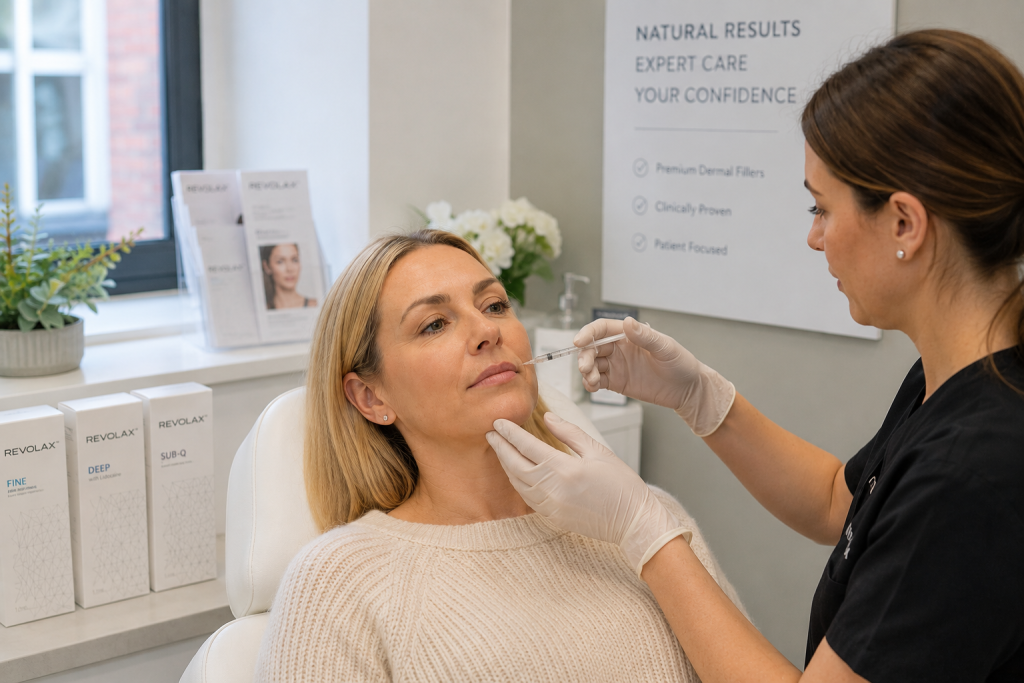
The Safety Picture Most Patients Miss Until It Is Too Late
Dermal filler safety in the UK sits inside a regulatory environment still catching up with the industry’s pace of growth. Revolax Deep Filler carries a CE-marked Class III certification; the risks that make headlines almost never connect to the product itself, but to who is holding the syringe. Currently, there is no law in England that states a practitioner must have any medical training or qualifications before he or she administers dermal fillers, other than the current rule banning treatment of anyone under the age of 18 years.
The Health and Care Act of 2022 provided the Secretary of State with the power to put a licensing scheme in place for non-surgical cosmetic treatments in England. As per the UK Government’s consultation paper for this scheme (as revised in August 2025), the intention behind the scheme is to make sure that the consumer is assured of the quality and safety of the treatment provided. (Source)
At present, one of the sources for the independent accreditation is the Save Face register, which comprises a list of registered practitioners. The Save Face register received around 3,000 complaints in 2022, and two-thirds of them were concerned with dermal fillers. This is important to note since it includes procedures done by people who never had their qualifications verified.
Vascular occlusion, where filler enters a blood vessel accidentally, sits at the serious end of what can go wrong. It is uncommon but can cause tissue necrosis and, near periorbital vessels, visual disturbance. It connects to technique, not the product itself. Every clinic should hold hyaluronidase on site and operate a written vascular occlusion protocol.
Questions Worth Asking Before You Book
| Question | Why Does It Matters? |
| Are you registered with GMC, NMC, GDC, or GPhC? | Confirms standing with a UK regulatory body |
| Do you hold hyaluronidase on site? | Non-negotiable for emergency complication management |
| How do you handle complications? | Should have a clear, documented protocol |
| Can you show me the product packaging? | Confirms genuinely sourced, professional product |
Vibe Pharma supplies professional aesthetic and healthcare products for practitioners and patients across the UK. They provide a reliable and accountable point of access for genuine injectables and pharmaceutical products.
Revolax Deep vs Other Options: Why the Product Is Only Half the Decision
Revolax Deep Filler holds a well-earned position in UK aesthetics for its consistent handling and clinically versatile viscosity. In such cases, patients comparing dermal fillers vs skin boosters will discover that the choice is not so much between the better product but rather whether the treatment is addressing the right issue.
The two products, Profhilo Filler and Plinest Skin Booster, act on an altogether different mechanism in improving the skin structure by bioremodelling the dermis without adding any volume or contour. For instance, the requirement for fuller lips and sharper chins would need a volumising filler. A patient whose main concern is skin texture or overall hydration may get far more from a booster. Many patients benefit from both at different points in a plan, which is worth raising during consultation rather than assuming one treatment covers everything.
The things to consider before dermal fillers ultimately circle back to a single question worth asking before any appointment: what outcome am I actually trying to achieve? The practitioner who begins by asking this question instead of simply sticking to his/her preferred product is the one who should be visited again.
Frequently Asked Questions
How long does Revolax Deep Filler last?
Approximately between 12 to 18 months for most people. Areas that move frequently, such as the lips, will usually last for about 12 months; while more stable areas such as the chin last longer.
Is Revolax Deep Suitable For Lip Augmentation?
Yes, for classic volume and definition. For the Russian lip technique, Revolax Fine is generally preferred due to its lighter, softer integration.
Can Anyone Legally Administer Dermal Fillers In The UK?
Not yet universally regulated. The patient needs to be assured that their doctor is registered with the GMC, NMC, GDC, GPhC, or the Save Face register.
What Is The Difference Between A Dermal Filler And A Skin Booster?
Fillers add volume and structural correction. Skin boosters improve skin quality and hydration without adding volume. Both can be used together within a treatment plan.
What If Something Feels Wrong After Treatment?
Contact your practitioner immediately. Disproportionate pain, skin blanching, or any visual change after filler treatment are warning signs of vascular occlusion and require urgent clinical attention.